Artificial Intelligence
New Smile.CX data: What CX leaders really value in a post-AI-hype market
27/06/2025
“AI-driven full resolution.”
“Emotionally intelligent automation.”
“Predictive, proactive service.”
These phrases have long dominated the language of customer experience, echoed across trend reports, vendor decks, and product roadmaps. But today, a growing number of decision-makers are asking: do we still believe the hype?
At Customer Contact Week (CCW) 2025 in Las Vegas, Smile.CX conducted a set of targeted surveys, engaging senior CX professionals across sectors. The signals were clear: the gap between promise and delivery in CX technology is widening, and leaders are shifting focus accordingly. The survey clearly shows that CX leaders now prioritize concrete proof over hype. The future of customer experience hinges on a pragmatic balance between technology and human expertise, focused on delivering real, measurable results.
When asked which CX capabilities feel most overpromised today, respondents were clear:
- 50% cited “AI-driven full resolution” as the top example of a capability that sounds good but rarely delivers.
- Others flagged emotion detection and routing (30.8%), predictive service (30.8%), and hyper-personalization(23.1%).
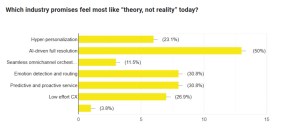
This reflects a broader sentiment we heard across titles and industries: leaders are exhausted by hypotheticals. What they want now is proof.
What leaders actually value in a CX partner
Looking to the future, we asked participants what would most influence their choice of a new CX partner by 2026. The responses show a move away from buzzwords toward measurable, adaptable collaboration:
- Pricing flexibility (38.5 %).
- Integration with existing tech stacks (34.6 %).
- Co-creation, speed, and transparency all tied at around 30.8 %.

These results indicate a growing preference for pragmatic, adaptable solutions over theoretical AI-driven visions. The ability to evolve fast, adapt to real-world constraints, and deliver tangible results is now the benchmark.
Proof over potential: The demand for evidence
Beyond feature checklists, respondents also showed a strong preference for evidence-based selling, frequently requesting case studies, KPIs, and clear deployment timelines. This consistent message, shared across both C-level and operational roles, was clear: they don’t want to be shown what’s merely possible, they want to see what’s actually working. This perspective helps explain why Smile.CX’s differentiators resonated with participants, not due to lofty AI promises, but because of its practical, human-in-the-loop orchestration models and real-time performance visibility.
When asked which capabilities from Smile.CX stood out compared to others, nearly 41% selected “the balance of AI and human interaction.”
Other top responses included:
- One-agent multitasking (18.2 %).
- Real-time sentiment and translation (18.2 %).
- Fast deployment (18.2 %).

This confirms that hybrid CX models, where automation supports, but doesn’t replace human talent, are becoming essential. The industry may be entering a “post-hype” AI phase, where operational realism is more valuable than innovation theater.
While the survey was targeted in scope, the consistency of the insights is hard to ignore: CX decision-makers are recalibrating their strategies around what’s credible, adaptable, and grounded. The future of great CX won’t be defined by how much AI it uses, but by how well it empowers the people delivering it.
Trust today is earned through evidence, not promises. If you’re rethinking CX around what truly works, get in touch.