Customer Experience

What is Omnichannel Customer Care and why it matters
23/06/2025
A customer starts a conversation via live chat. Minutes later, they call the contact center. The next day, they send a follow-up email. In every interaction, they expect one simple thing: that the company remembers who they are, what they asked, and where the conversation left off. This is the foundation of omnichannel customer service—a unified, tech-enabled approach that ensures continuity across all support channels. This isn’t a technical evolution. It’s a redefinition of how customer value is managed across the business.
What is omnichannel customer service
Being available on multiple channels is no longer enough. The real breakthrough happens when those channels work together, delivering a seamless and consistent experience. That’s the difference between multichannel support and true omnichannel support.
So, what is omnichannel customer service, really? It’s not just about having voice, email, chat, mobile apps, social media, and AI-driven customer chatbots. It’s about orchestrating all these touchpoints into a coherent, connected customer journey.
In the United States, customer expectations have evolved dramatically in recent years. Today’s consumers demand immediate, personalized support—anytime, anywhere. A report by Salesforce shows that 83% of customers expect to interact with someone immediately when they contact a company, and others expect brands to understand their unique needs and expectations.
Omnichannel customer care addresses these demands by providing speed, consistency, and reduced friction. Most importantly, the frustration of repeating information is eliminated—resulting in higher satisfaction, greater loyalty, and improved Net Promoter Score (NPS).
For decision makers, the equation is simple: every disconnected interaction costs margin, satisfaction, and loyalty. Omnichannel isn’t just a CX improvement—it’s a radical redistribution of value across the organization.
From Multichannel to Omnichannel: The business shift that matters
For years, many organizations assumed that being “available everywhere” meant being customer-centric. But the shift from multichannel to omnichannel isn’t a tech upgrade. It’s a redistribution of value across the entire business architecture.
Where multichannel offers isolated options, omnichannel builds a unified ecosystem—one where context follows the customer, and support becomes a connected experience rather than a sequence of repeated frustrations.
For decision-makers, this shift impacts far more than CX metrics. It redefines how value is created, measured, and, in many cases, silently lost across customer operations. Here’s what that means in concrete terms:
- Shift from channel-based costs to journey-based outcomes: Measuring the cost of each individual channel (voice, chat, email) creates a false sense of efficiency. What matters is the cost of resolving a customer issue across the full journey—regardless of how many touchpoints are involved. That’s where inefficiencies accumulate and value is lost.
- Dismantle service silos and manage experience as a value stream: Each interaction isn’t an isolated transaction—it’s a part of a broader commercial flow. Treating service channels as standalone functions fragments data, disconnects teams, and prevents the organization from capturing full-cycle customer value.
- Reframe the cost to serve: from time-to-resolution to impact of non-resolution: Traditional metrics like Average Handling Time (AHT) fail to capture the real business impact. The true cost lies in delays, repeated contacts, and missed opportunities caused by the inability to resolve issues in the first interaction, through the right channel.
- Redefine agent productivity in terms of strategic contribution: It’s not about volume handled—it’s about value unlocked. An agent who solves fewer but strategically critical issues, at the right moment in the journey, contributes more to revenue protection and growth than one who closes dozens of low-impact tickets.
Omnichannel Support vs. Multichannel Support
- Isolated Data vs. Shared Context: In a multichannel setup, each channel retains its own data, forcing customers to repeat information. In an omnichannel approach, all interactions draw from a unified customer profile.
- Fragmented Experience vs. Seamless Journey: Multichannel treats each touchpoint as a separate interaction, while omnichannel delivers a continuous and uninterrupted customer journey.
- Separate Systems vs. Unified Ecosystem: Traditional multichannel environments rely on different tools for each channel. Omnichannel integrates everything into a single, cohesive platform.
To fully appreciate the impact of omnichannel support, it helps to understand how it compares to the legacy multichannel model:
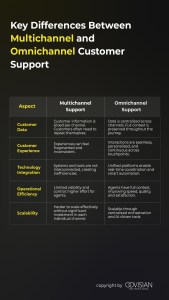
Multichannel VS Omnichannel customer support. Source: Covisian
Companies that delay this transition pay the price in invisible inefficiencies: higher churn, missed upsell opportunities, and an inflated Cost to Serve masked by siloed metrics. The real risk isn’t being late to omnichannel—it’s running a model that quietly erodes value, until it’s too late to recover.
Core Customer support channels
A successful omnichannel strategy isn’t just about being “everywhere”—it’s about being strategically connected where it matters most. For U.S. companies, the goal is to meet customers where they are, on their terms, and ensure that every interaction—no matter the channel—feels intuitive, seamless, and informed by the full context of the relationship.
Today’s consumers move fluidly across digital platforms—and they expect brands to do the same. Social media is no longer just a place for marketing; it’s a frontline service channel with tangible business impact. According to McKinsey, customers spend 20% to 40% more with companies that respond to service requests on social platforms. Yet, many companies still treat messaging and social platforms as secondary channels, missing the opportunity to intercept leads and engage customers at the moment of highest intent.
The cost of ignoring this shift? A 15% higher churn rate compared to businesses that actively engage with customers in these spaces. Failing to deliver that continuity comes at a cost—not just in CX metrics, but in revenue.
Here are the critical support touchpoints shaping today’s customer experience landscape—and what they each bring to the table when integrated into an omnichannel framework.
Phone & VoIP (Voice over Internet Protocol)
When voice channels are deeply integrated with CRM platforms, they stop being reactive cost centers and start acting as real-time intelligence hubs. As a result, conversations become faster and smarter, consistently meeting FCR and AHT goals, while allowing senior agents to focus on high-value interactions. For companies handling thousands of inbound calls each month, this isn’t just a matter of convenience; it’s a strategic gain in cost-efficiency and resource ROI.
Web & In-App Chat (Live Chat & In-App messaging)
During demand spikes, support teams often find themselves buried under repetitive requests, order statuses, returns, login issues. You don’t need to expand the team, you need to unleash it. By automating low-complexity interactions, intelligent chat solutions unlock capacity where it matters most: complex cases, premium customers, and moments where empathy drives outcomes. For decision makers, this means a measurable drop in Average Handling Time (AHT), reduced SLA breaches, and a support operation that scales with demand, without scaling cost. It’s not about doing more with less. It’s about doing what matters, faster.
Email & Ticketing Systems (Ticketing systems – Help Desk platforms)
To manage complex cases, such as legal requests, compliance, returns, or multi-team escalations, email remains essential. But unmanaged inboxes quickly turn into black holes of inefficiency. The real problem isn’t the channel, it’s the lack of structure. Modern ticketing platforms turn every message into a measurable task: assigned, prioritized, and tracked. For managers, it’s not just a visibility gain, it’s operational control. You get audit trails, SLA dashboards, and the ability to scale without compromising quality. Integrated into your CX stack, this becomes a force multiplier: fewer escalations, faster resolutions, and measurable impact on customer satisfaction.
Social & Messaging Apps (Social messaging channels)
Channels like Facebook Messenger, Instagram Direct, Apple Messages for Business and SMS have evolved into significant customer service channels. Customers expect quick, helpful responses, often in public view. When social and messaging apps are integrated into your CX ecosystem, agents manage them like any other case: triaged, tracked, resolved. This reduces reputational risk, increases response consistency, and ensures greater brand trust, stronger retention, and fewer costly escalations.
AI-Driven Customer Chatbots (Conversational AI)
When 30% of inbound volume is made up of repeatable questions, the choice isn’t between agents and bots, it’s between scale and stagnation. AI chatbots, when deeply integrated with backend systems, handle routine interactions autonomously—status updates, password resets, FAQs—while maintaining full context across channels. For operations leaders, that translates to measurable wins: reduced cost-per-contact, 24/7 availability, and better use of live agents where human value is highest. It’s not automation for the sake of it. It’s a strategic tool to absorb growing volumes without growing headcount, while keeping CSAT and AHT right where they should be.
The real differentiator? It’s not the presence of these channels—it’s their ability to communicate with each other. For forward-looking companies, true omnichannel orchestration doesn’t mean just investing in seamless experiences—it means reorganizing teams around journey flows, aligning KPIs across functions, and treating operational efficiency and revenue capture as two sides of the same equation.
Business and customer benefits of Omnichannel Customer Care
A unified support environment unlocks measurable benefits—for customers and for the business alike. For businesses, omnichannel support means greater efficiency. When agents have real-time access to full customer histories, they resolve issues faster, reducing average handle time (AHT) and improving first contact resolution (FCR). Integrated platforms enable robust reporting and dashboards, helping leaders make data-driven decisions. And by automating common requests with AI-driven chatbots or voicebots, companies can cut costs while scaling service capacity.

Customers, in turn, enjoy a consistent and frustration-free experience. They don’t have to repeat themselves. They don’t have to guess which channel works best. And they don’t feel like they’re starting from scratch every time they reach out. This continuity leads to faster resolutions, higher satisfaction scores, and stronger loyalty. In fact, brands that prioritize seamless omnichannel experiences see up to 9.5% year-over-year growth in annual revenue, according to research by Uniform Market. In the end, omnichannel care isn’t just good CX—it’s smart business.
Redefining the CX-BPO Model
In the U.S., customer experience can make or break brand loyalty. According to Forrester, a one-point improvement in CX Index can generate more than $1 billion in additional revenue for large enterprises. To capture that value, companies need more than operational efficiency—they need a BPO model designed for strategic impact. These models go beyond cost savings and ticket resolution—they’re designed to unify people, processes, and platforms around measurable impact.
A best-in-class CX-BPO strategy typically integrates four foundational pillars:
1. End-to-End omnichannel CX delivery
A true omnichannel approach doesn’t just enable customer interactions—it structures them for value creation. By designing support models that span the entire lifecycle (from acquisition to loyalty), businesses can reduce operational handoffs, eliminate blind spots, and turn each contact into a data-rich opportunity. Whether it’s pre-sale consultation, issue resolution, or proactive retention, an orchestrated CX model ensures continuity, accelerates outcomes, and creates compounding value across the funnel.
2. Strategic CX consulting
Optimizing customer experience starts with rethinking the journey itself. Strategic consulting helps companies diagnose structural weaknesses in the journey, prioritize high-impact fixes, and align CX initiatives with enterprise goals. This is where cost-efficiency meets growth: reducing churn, unlocking cross-sell moments, and driving measurable business outcomes. From redesigning KPIs to aligning CX architecture with brand promise, consulting provides the clarity needed to turn experience into competitive advantage.
3. Digital CX advisory
Implementing digital tools is only part of the transformation. The real value comes from orchestrating those tools around a long-term vision. Advisory services that focus on governance, integration, and automation help organizations avoid siloed deployments and instead build scalable, connected experiences. This might mean deploying conversational AI for common inquiries, digitizing workflows to improve resolution times, or optimizing the mix of channels to match evolving customer behavior. With the right digital advisory in place, businesses can evolve from reactive service models to proactive value delivery.
4. CX-Enabling technology
Technology is no longer an enabler—it’s a differentiator. Unified agent workspaces, context-aware routing, and real-time customer intelligence are the new baseline. The goal isn’t just faster resolution—it’s precision service that protects margin, increases loyalty, and feeds continuous improvement loops. Smart platforms allow companies to act on insight, adapt in real time, and embed resilience into their CX operating model. When technology becomes part of the business core—not just the tech stack—it transforms service from a cost center into a source of strategic advantage.
The future of CX-BPO lies in its ability to create value beyond the transaction. When digital innovation and human expertise are aligned, every interaction becomes a lever for customer loyalty, revenue generation, and long-term differentiation. This is not outsourcing as it once was. It’s a more adaptive, intelligence-led model—built for businesses that treat customer experience as a core part of their competitive strategy.
Powering the omnichannel experience: enabling technologies
Today’s market leaders aren’t just improving customer experiences—they’re reengineering their operational core to deliver measurable ROI. Behind every seamless omnichannel journey lies a strategic tech stack that improves time-to-resolution, reduces customer churn, and increases agent utilization rates. For executives focused on growth and efficiency, investing in integrated CX technologies means unlocking new levers of cost control, customer lifetime value, and real-time responsiveness.
- AI-Driven customer chatbots do more than deflect volume. By resolving up to 60–70% of repetitive queries autonomously, they reduce average handling time (AHT), cut cost-per-contact, and preserve human agents for high-value interactions. For CX leaders this means faster scalability, reduced onboarding time, and a streamlined path to 24/7 support without proportional increases in staffing.
- Voicebot solutions are redefining traditional IVR systems—no longer limited to rigid, keypad-based menus, but enabling natural, intelligent interactions that scale with demand. Smile.CX exemplifies this shift with a voicebot capable of managing complex conversations in a fluid, human-like way—adapting to tone, recognizing intent, and learning continuously from past interactions. For businesses, the impact is measurable. Up to 90% of users complete interactions successfully without human escalation—a clear signal that automation doesn’t have to feel impersonal. In high-volume environments, Smile.CX handles peaks of over 12,000 calls per month, cutting average wait times that once exceeded five minutes and enabling support teams to scale efficiently without increasing headcount. The result? Lower abandonment rates, reduced Cost Per Contact (CPC), and greater First Call Resolution (FCR)—all supported by seamless backend integration and intelligent routing that ensures human agents are engaged only when truly needed. For leaders focused on sustainable growth and operational ROI, solutions like Smile.CX turn call centers into engines of efficiency, not cost centers.
- Predictive customer analytics help turn customer data into a strategic advantage. By spotting early signs of churn, recognizing your most valuable segments, and surfacing the right moment for a cross-sell, they allow businesses to stay one step ahead. The impact? Stronger Customer Lifetime Value (CLV), a healthier Average Revenue Per User (ARPU), and better Net Promoter Scores (NPS). With the right insights at the right time, decision-makers can shift from reactive firefighting to proactive growth—making every interaction count.
- Channel orchestration platforms serve as the backbone of a unified customer experience. These platforms ensure that whether a customer starts on social media, moves to chat, and escalates to voice, the experience remains consistent—context-aware, personalized, and fluid. For business leaders, this eliminates fragmentation and gives a true 360° view of customer behavior in real time.
- Workforce engagement management (WEM) tools are essential for companies to rethinking how they manage their service teams, not just to save costs, but to create real strategic value. This is where solutions like Smile.CX truly stand out. Its platform does more than scheduling shifts—it becomes a way to make smarter use of every agent, every hour, and every customer touchpoint. That means less time spent on routine calls, and more time invested in driving value through empathy, expertise, and upsell potential. With real-time visibility into availability, predictive planning based on historical data, and automated reporting on KPI like Agent Utilization Rate, Average Handling Time (AHT), and Service Level (SL), managers can make faster, more informed decisions. The outcome? Lower operational costs, better workforce productivity, and a team that’s aligned, engaged, and consistently performing at its best.
Incorporating these technologies is the backbone of omnichannel strategy. They don’t just support the journey—they power it, evolve it, and ensure that every interaction, whether human or automated, contributes to a unified, intelligent customer experience.
One Strategy, many sectors: Omnichannel at work
No matter the industry, one thing holds true: customers don’t care about your internal silos—they just want things to work. That’s where omnichannel customer care makes all the difference. Across sectors, we’re seeing some standout patterns in how organizations bring this to life. From telecom to healthcare, here’s how different industries are turning seamless support into real-world impact:
- Telecommunications: Dropped calls, billing questions, data plan changes—telecom support has to move fast. By linking chat, mobile apps, and voice into one coordinated flow, providers can handle tickets smarter and faster. Customers get the help they need without dead ends or déjà vu.
- Finance & Insurance: Filing a claim or disputing a charge shouldn’t feel like a maze. Banks and insurers are streamlining these high-stakes interactions with secure, unified workflows across apps, web, and messaging. The goal: fast answers, fewer callbacks, and full visibility for both sides.
- Retail & E-commerce: Lost packages, late deliveries, or sizing questions—shoppers expect instant answers wherever they ask. Retail brands are using APIs to power real-time support across email, chat, and social DMs, all tied back to order systems. It’s support that matches the pace of online shopping.
- Utilities: Nobody wants to sit in the dark—literally or figuratively. Utilities are stepping up with proactive SMS alerts, customer portals, and self-service tools that keep users informed during outages and beyond. It’s about staying ahead of issues and cutting down call center spikes.
- Healthcare: Appointments, prescriptions, follow-ups—healthcare is personal and time-sensitive. Providers are using omnichannel systems to help patients book visits, receive reminders, and ask follow-up questions without jumping through hoops. Better communication, better care.
Omnichannel customer care isn’t just a trend—it’s the foundation of modern CX. From voicebots that respond with empathy to real-time orchestration across chat, email, and social, today’s leading businesses are shifting from fragmented support to fully connected journeys. No matter the industry, the message is clear: customers stay loyal to experiences that feel effortless, connected, and human.
Ready to transform your customer care into a seamless omnichannel experience? Request a free demo! Let us show you what’s possible when smart tech meets real-world CX needs.
FAQ
What is the difference between multichannel and omnichannel support?
Multichannel support offers multiple, separate channels for customer interaction, while omnichannel support integrates these channels to provide a seamless customer experience.
How do AI chatbots improve resolution times?
AI chatbots handle routine inquiries instantly, freeing up human agents to focus on complex issues, thereby reducing overall resolution times.
What does a channel orchestration platform do?
It synchronizes customer interactions across various channels, ensuring consistent and efficient communication.
How can WEM tools boost agent productivity?
Workforce Engagement Management tools optimize agent scheduling, provide coaching, and monitor performance, leading to increased productivity and job satisfaction.