Innovation

Top 10 CCaaS platforms in the USA in 2025 | Full comparison
01/08/2025
In this guide, we compare the top 10 CCaaS platforms in the USA for 2025, highlighting key differentiators such as scalability, AI capabilities, omnichannel orchestration, and compliance. Our analysis aims to help CX leaders select the right platform to improve KPIs like FCR, CSAT, and AHT while optimizing operational costs.
Why CCaaS Is Critical for Customer Experience in 2025
The CCaaS (Contact Center as a Service) market in the U.S. is booming, pushed by digital transformation, remote work, and rising customer expectations. With research forecasting that over 70% of enterprises will adopt CCaaS by 2026, the right platform becomes a strategic asset affecting critical KPIs: NPS, cost-to-serve, and Customer Lifetime Value (CLV). This comparison serves C-level executives and CX leaders seeking the best CCaaS platform to boost their results in 2025–26.
Quick View: Top 10 CCaaS Platforms in the USA (2025)
- Five9
- Genesys Cloud CX
- Smile.CX
- NICE CXone
- Talkdesk
- 8×8 Contact Center
- Amazon Connect
- Cisco Webex Contact Center
- Avaya OneCloud
- RingCentral Contact Center
See full detailed comparison below.
Contact Center as a Service (CCaaS) is a cloud-based model that enables organizations to deliver customer service via a flexible, scalable, and AI-powered platform, without the need for on-premise infrastructure. Instead of relying on fragmented or legacy systems, businesses use CCaaS to centralize all interactions across voice, chat, email, social, and messaging apps in one intelligent environment.
Customer experience (CX) is already a baseline expectation. Customers demand frictionless, omnichannel, real-time support, and they don’t tolerate inconsistency across touchpoints.
Meanwhile, service teams are under pressure to reduce operating costs, shorten resolution times, and improve KPIs like Average Handle Time (AHT) and First Contact Resolution (FCR), often with fewer resources.
This is where CCaaS becomes indispensable providing:
- AI-powered routing and automation, ensuring the right agent handles the right issue at the right time.
- Omnichannel orchestration, keeping context consistent across touchpoints.
- Real-time analytics and predictive insights, enabling managers to act before issues escalate.
Failing to adopt CCaaS in this climate means more than just falling behind, it can lead to higher churn, longer resolution times, and lower customer lifetime value (CLV).
Key Factors to Consider When Choosing a CCaaS Platform
Not all CCaaS solutions are created equal. For enterprise decision-makers, the right platform can accelerate transformation, while the wrong one can stall it. Whether your priority is reducing the cost per lead, increasing resolution rates, or enabling smarter workforce allocation, these five pillars are essential in evaluating a modern CCaaS stack.
Scalability and Flexibility
CX leaders must respond fast to seasonal peaks, product launches, or unexpected volume spikes. Traditional systems often crack under pressure, leading to increased wait times, dropped interactions, and lost revenue. Without flexible infrastructure, customer experience suffers, and so do your KPIs.
Modern CCaaS platforms solve this with instant provisioning across regions, pay-as-you-go pricing that keeps fixed costs low, and cloud-native reliability that guarantees availability even during demand surges. This agility isn’t just technical: it’s strategic. It means your organization can adapt in real time, seize growth opportunities, and maintain service continuity when it matters most.
Impacted KPIs:
- Cost per Contact (CPC).
- SLA Adherence.
- Peak-time Abandonment Rate.
Omnichannel Support
Customers no longer see channels. They see one brand. Whether they’re messaging you on WhatsApp, calling support, or interacting through your app, they expect the same speed, tone, and context. When that consistency breaks, the experience feels fragmented. This creates friction, forces customers to repeat themselves, and increases churn.
From a manager perspective, this is not just a CX issue but a direct risk to revenue and brand reputation. Every dropped conversation or inconsistent interaction reduces Customer Lifetime Value (CLV), weakens loyalty, and increases the likelihood of negative public feedback. Poor omnichannel orchestration doesn’t just frustrate customers, it erodes business performance.
Modern CCaaS platforms unify all touchpoints, enabling agents to move across channels with full visibility into the customer’s journey. This results in faster resolutions, more efficient operations, and a consistent brand experience.
Impacted KPIs:
- First Contact Resolution (FCR).
- Customer Satisfaction Score (CSAT).
- Average Handle Time (AHT).
- Customer Lifetime Value (CLV).
AI and Automation Capabilities
AI is a core driver of efficiency, quality, and scalability across the contact center. With growing interaction volumes and pressure to reduce costs, businesses need AI-powered tools to support both customers and agents.
AI-driven CCaaS platforms use predictive routing, conversational bots, and genAI powered virtual assistants to reduce manual workloads and speed up resolutions. This allows companies to automate repetitive tasks while focusing human agents on higher-value, complex cases. For leadership, this means lower operational costs and more strategic use of talent without compromising service levels.
Impacted KPIs:
- Average Handle Time (AHT).
- Agent Utilization Rate.
- Cost per Interaction.
- Escalation Rate.
Integration and Ecosystem Compatibility
Modern customer service relies on seamless connections between systems. A CCaaS platform that integrates with your CRM, ERP, business intelligence, and workforce tools creates a unified ecosystem that drives both efficiency and insight.
For CX executives, integration isn’t a technical feature, it’s a productivity multiplier. When data flows freely across platforms, agents can personalize service, managers can monitor KPIs in real time, and IT can reduce complexity. Siloed systems, on the other hand, increase resolution time, reduce accuracy, and create costly friction across departments.
A CCaaS platform with strong API support and plug-and-play connectors accelerates digital transformation and improves the end-to-end customer journey.
Impacted KPIs:
- Resolution Time.
- First Contact Resolution (FCR).
- Data Accuracy/Error Rates.
- Operational Efficiency.
Security and Compliance
In regulated industries like healthcare, finance, and insurance, protecting customer data is non-negotiable. Compliance is not only about avoiding fines but about maintaining trust in every interaction.
Today’s leading CCaaS platforms offer enterprise-grade security features such as end-to-end encryption, secure data storage, and granular access controls. They also provide built-in compliance with global standards like SOC 2, HIPAA, and GDPR, ensuring that your operations meet legal requirements across markets.
This translates into lower risk exposure, faster audits, and a stronger foundation for innovation, especially when scaling globally or entering sensitive verticals.
Impacted KPIs:
- Security Incident Frequency.
- Compliance Audit Pass Rates.
- Net Promoter Score (NPS).
- Customer Trust Index.
The Top 10 CCaas Platforms in the USA in 2025
Five9
Five9 delivers a robust, easy-to-use platform that emphasizes voice quality, outbound efficiency, and global reach. Its intuitive interface and strong VoIP architecture make it a solid choice for teams prioritizing reliable customer engagement and campaign-driven outreach. Five9 supports hyper-targeted outbound efforts, enabling businesses to drive sales and re-engagement via optimized voice, sms, and email. The platform is PCI compliant and simplifies global expansion with local presence. Its built-in workforce management tools streamline scheduling and forecasting, essential for enterprise-grade operations.
Pros
- Best-in-class outbound campaign capabilities.
- High-quality voice infrastructure with global availability.
- Ease of use and quick onboarding.
Cons
- Limited built-in AI, often requires external add-ons.
- Advanced analytics may need additional integrations.
Genesys Cloud CX
Genesys Cloud CX provides a powerful, modular suite with AI-powered routing, agent assist, and real-time journey analytics. Its platform architecture allows seamless scalability for global teams and cloud-native deployments. Genesys supports advanced self-service automation and predictive engagement, helping to anticipate customer needs before they surface. It integrates well with major CRMs, enabling data-driven insights across the customer lifecycle. Its unified agent interface delivers efficiency gains and helps maintain consistent CX standards across channels.
Pros
- Intelligent routing and agent assist powered by AI.
- Deep integration with CRM and workforce systems.
- Scalable global architecture.
Cons
- Licensing can be complex to navigate.
- Some advanced features may still require configuration.
Smile.CX
Smile.CX is a next-generation CCaaS platform built to deliver true orchestration across every touchpoint (voice, chat, email, SMS, and WhatsApp) through a cloud-native, modular architecture. Designed for adaptability, its ecosystem allows organizations to deploy only the components they need, whether starting with a few channels or scaling to full omnichannel operations powered by AI.
What sets Smile.CX apart is its hybrid interaction model: customer journeys begin with human agents to build trust, then flow into AI-powered automation to handle repetitive tasks and streamline resolution. This combination has delivered measurable outcomes, including a 52% reduction in handling time, +23% gain in agent productivity, and a 9% uplift in customer satisfaction.
For CX leaders, the platform provides real-time dashboards and predictive KPIs, helping drive smarter planning, faster interventions, and clear ROI on transformation efforts. Unlike many siloed solutions, Smile.CX unifies people, processes, and AI under one cohesive framework, empowering organizations to future-proof their service model while improving key customer and operational KPIs.
Pros:
- Proven reduction in handling time and agent productivity.
- Modular design adapts to business needs and digital maturity.
- AI and human-first orchestration from day one.
- Predictive insights and real-time KPI monitoring.
Cons:
- May require strategic integration planning for enterprise CRMs or legacy systems.
- The full set can represent a significant investment for small businesses,but Smile.CX offers modular packages specifically designed, both operationally and economically, for small and mid-sized businesses.
NICE CXone
NICE CXone is often regarded as one of the most mature and feature-rich CCaaS platforms in the market. Built for large-scale, global deployments, it combines deep capabilities in workforce engagement management (WEM), AI-driven analytics, and omnichannel orchestration into a single cloud-native environment.
What truly differentiates NICE is the scope and depth of its AI and analytics infrastructure, powered by proprietary large language models (LLMs) and years of labeled CX data. This empowers enterprise leaders to deploy predictive insights, automate routing and coaching, and drive measurable improvements in agent efficiency and customer satisfaction. NICE also earns high marks for its simple admin UI, scalable architecture, and extensive global support services.
Pros:
- Broadest capability set across WFO, AI, analytics, and agent tools.
- Strong GenAI integration with proven performance at scale.
- Trusted for complex global rollouts.
- User-friendly admin interface praised by enterprise teams.
Cons:
- Implementation can be complex and require longer onboarding.
- High-end pricing may not suit mid-sized contact centers.
Talkdesk
Talkdesk takes a vertical-first approach to CCaaS, offering industry-specific clouds tailored for healthcare, financial services, retail, and more. Each version includes pre-built workflows, deep integration options, and compliance modules specific to the sector, making it especially appealing for regulated industries.
Its cloud-first infrastructure and growing suite of GenAI tools help enterprises customize and automate customer journeys with high precision. Additionally, its consultative customer success teams and technical account managers provide ongoing strategic guidance, helping organizations maximize the platform’s flexibility and speed-to-value.
Pros:
- Tailored, industry-specific solutions with sector-native workflows.
- Strong cloud foundation and GenAI investments.
- High customizability and responsive enterprise support.
- Increasing traction with large organizations.
Cons:
- Limited WFM and reporting capabilities.
- Smaller partner ecosystem and lower presence outside NA/EU.
8×8 Contact Center
8×8 Contact Center stands out for its unified approach, merging UCaaS, CCaaS, and CPaaS into one coherent solution. This integrated model simplifies vendor management and allows for seamless internal and external communication, ideal for midmarket enterprises seeking efficient deployment and low friction.
It also offers robust global telephony infrastructure, known for reliability and compliance, and a native Microsoft Teams integration, making it an attractive option for businesses already embedded in Microsoft’s ecosystem. The platform’s ability to aggregate customer data from multiple sources enables smarter routing and analytics without the need for heavy custom development.
Pros:
- Unified platform across UCaaS, CCaaS, and CPaaS.
- Global telephony coverage with enterprise-grade reliability.
- Ideal for midmarket firms and Microsoft Teams users.
- Strong data aggregation for routing and analytics.
Cons:
- Limited AI and GenAI capabilities compared to leaders.
- May lack the advanced features required for large enterprise CX operations.
Amazon Connect
Amazon Connect is a fully cloud-native, omnichannel contact center solution that brings enterprise-grade CX capabilities to businesses of all sizes. It supports voice, chat, SMS, email, and in-app or video interactions through a unified agent desktop, with context maintained across channels. Designed for rapid deployment, Connect allows companies to go from zero to fully operational in hours or days, dramatically reducing time-to-market compared to traditional platforms.
Its tight integration with AWS services empowers organizations to adopt GenAI, chatbots, and speech analytics at scale using tools like Amazon Lex, Polly, and Contact Lens. A recent enhancement includes a Zero‑ETL analytics data lake, enabling real-time access to contact center data and customizable reports through BI tools like QuickSight.
Pros:
- Revolutionary deployment speed, support remote agents in hours.
- No upfront cost, highly flexible pricing model.
- Seamless access to AWS AI and analytics ecosystem.
- Unified view of multi-channel interactions.
Cons:
- Requires AWS expertise to fully exploit advanced features.
- Native analytics and UI less mature than some standalone CCaaS leaders.
Cisco Webex Contact Center
Cisco Webex Contact Center offers a unified solution that combines CCaaS, UCaaS, and CPaaS to support both customer engagement and internal collaboration. Its global telephony infrastructure ensures reliable, high-quality voice services, while features like agent-to-expert swarming and seamless escalations help improve First Contact Resolution and CX outcomes. Cisco also prioritizes agent well-being through its “Agent Wellness” module, which monitors stress levels and suggests interventions to prevent burnout.
Pros:
- Strong integration between CCaaS, UCaaS, and CPaaS for unified enterprise communications.
- Advanced agent support tools, including the unique “Agent Wellness” feature.
- Global telephony reach with enterprise-grade voice quality.
- Active partner ecosystem and strong enterprise adoption rates.
Cons:
- User experience can feel disjointed across the Webex suite.
- Admin interfaces are less unified than top competitors.
- SLA terms may fall short of industry leaders for mission-critical environments.
Avaya OneCloud
Avaya OneCloud is positioned as a flexible, hybrid CCaaS platform built to support organizations transitioning from legacy on-premise systems to cloud-native environments. It appeals particularly to enterprises with complex telephony infrastructures or those requiring gradual migration paths. OneCloud offers omnichannel customer engagement, with strong voice capabilities and support for digital channels like chat, messaging, and email.
Avaya emphasizes customization and integration, allowing organizations to build tailored experiences while maintaining control over data residency and compliance, especially relevant in regulated industries.
Pros:
- Strong fit for hybrid deployments and phased cloud migration.
- Reliable voice infrastructure with enterprise-grade telephony.
- High customizability and regulatory flexibility.
Cons:
- Limited innovation pace compared to fully cloud-native vendors.
- Complexity of legacy integrations can slow down time-to-value.
RingCentral Contact Center
RingCentral Contact Center is a robust CCaaS platform tailored for enterprises seeking deep voice expertise and seamless integration with unified communications. It’s particularly attractive to companies that already leverage RingCentral’s UCaaS for internal communications, offering a cohesive environment for both customer and employee interactions.
The platform supports omnichannel routing, AI-assisted workflows, and customizable agent dashboards. Its strengths include ease of deployment, a modern UI, and native workforce management (WFM) tools. RingCentral also provides strong analytics capabilities and pre-built CRM integrations that reduce friction in daily operations.
Pros:
- Tight integration with RingCentral UCaaS for unified comms.
- Scalable and easy to deploy with strong analytics.
- Native WFM and omnichannel routing.
Cons:
- AI capabilities still maturing relative to top-tier platforms.
- May be overengineered for smaller or less complex operations.
Conclusion & Next Steps
As customer expectations continue to rise and service models grow more complex, adopting a modern CCaaS platform is no longer optional, it’s a strategic imperative. From AI-powered automation to omnichannel orchestration and real-time analytics, the right solution doesn’t just improve customer service; it transforms your entire operating model.
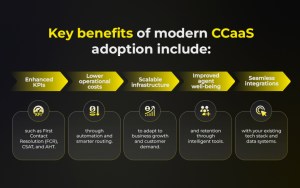
Whether you’re leading a CX transformation or optimizing a global contact center footprint, choosing the right platform will define your competitive edge in 2025 and beyond.
If you’re exploring a modular, AI-driven approach to contact center transformation, get in touch for a personalized demo and see how we can elevate your CX.
Next steps:
- Define your CX priorities.
- Align with key KPIs.
- Pilot the platforms that best match your operational and strategic goals.